Highways bosses comfortable Preston can cope with loss of almost 800 parking spaces for Fishergate redevelopment
The county council was responsible – along with the city council and the University of Lancashire – for drawing up the Station Quarter Regeneration Framework
Highways bosses have insisted that the impact on Preston of losing almost 800 parking spaces – at the same time as bringing potentially thousands of new workers into the city – will be manageable.
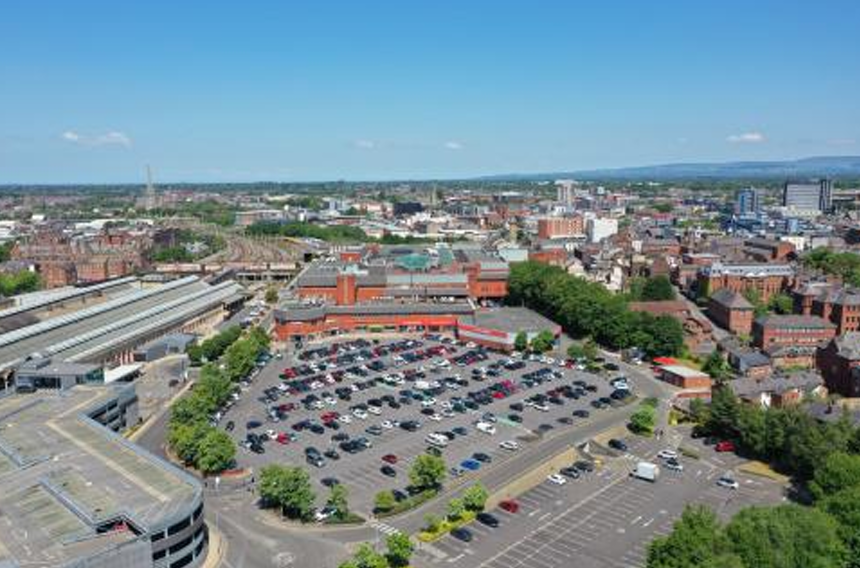
Plans to build five high-rise office blocks on the car park of the Fishergate Shopping Centre were approved by Preston City Council’s planning committee earlier this month.
However, the meeting at which the decision was made heard that it had taken almost a year of negotiations to persuade traffic chiefs at Lancashire County Council – which is responsible for the road network in Preston – that the redevelopment was acceptable.
Mitigation measures were eventually agreed which assuaged County Hall’s concerns. They will require the Fishergate centre’s owners, The Martin Property Group – the firm behind the scheme – to carry out an annual survey for five years after the offices come into operation, identifying how workers are commuting and, if it is by car, where they are parking.
Where there is “reasonable evidence” of a significant impact on on-street parking, controlled parking zones and resident permit schemes will be implemented – and funded by the company.
A planning agreement will also see the firm contribute £100,000 towards the installation of “intelligent CCTV technology” which will improve road reliability – especially during the morning and evening peaks or when an incident occurs.
The office development will also come with 238 bicycle storage spaces and 42 disabled parking bays.
The county council was responsible – along with the city council and the University of Lancashire – for drawing up the Station Quarter Regeneration Framework, of which the Fishergate car park redevelopment plans are a part.
Nevertheless, the starting point for the authority’s highways officials was that the car park’s closure – coupled with the construction of the new offices – would leave Preston short of more than 2,500 parking spaces.
That calculation was based on a combination of losing the 780 spaces on the Fishergate site itself and on upon consideration of the city council’s own parking standards. Under local planning policy, the authority would usually demand 1,746 spaces for a development on the scale of the planned office blocks.
However, those standards can be lowered for sites with access to good public transport links – and the planning committee was told that the site’s proximity to the railway and bus stations made it “the most sustainable area of the city centre”.
Transport consultants WSP – acting for the applicant – argued that providingv1,746 spaces would “significantly exceed anticipated demand” for the parking to be generated by the new office workers.
The firm estimated that there would actually be “a peak accumulation” of just 415 vehicles, during the mid-morning period.
It also undertook analysis of the occupancy rate of the Fishergate car park – which surveys have shown is below 60 percent on weekdays – and of 10 alternative nearby parking facilities which are between 50 and 80 percent occupied Monday to Friday.
Using those figures, WSP came up with a worst-case scenario under which those alternative car parks would be able to provide 1,006 spaces to accommodate the 415 parking spots required by office workers and to fulfil the demand from those who would otherwise have parked at Fishergate, but had been displaced – another 470 vehicles, based on the assessed 60 percent occupancy level.
The resultant total of 885 spaces estimated to be needed would come in 121 below the 1,006 expected to be available at other sites.
Preston City Council considers there currently to be an oversupply of parking in the city centre. In response to concerns raised by some members of the planning committee about the loss of Fishergate as an option, town hall planning officer Patrick Marfleet said the city council was content that analysis had proved there was sufficient capacity both for visitors to Preston and the influx of new workers – not least because the location of the offices encouraged “a shift” away from car travel.
However, David Staniland, the agent for the application said the issue had been “a bone of contention” with Lancashire County Council until recent weeks.
Asked by the Local Democracy Reporting Service (LDRS) about its initial concerns, the county council said via a spokesperson: “We carefully considered the highways and transport implications of the redevelopment, including the impact of the loss of parking at the Fishergate Centre.
“We worked with the developer to secure measures to keep traffic moving and provide safeguards for surrounding residential areas if parking issues arise. These measures will ensure the impact on traffic and parking can be effectively managed on the highway network.”
No starting date has been set for building work on the car park. Further permission for the detailed design of the buildings – which will range from nine to 15 storeys in height – will first be required. The planning committee was also told that each of the office blocks would be constructed only once an occupant was confirmed.
The broader station quarter plans – if fully realised – will ultimately see the Fishergate Shopping Centre itself demolished and replaced with residential, leisure and retail facilities, along with a new public square. However, those elements of the scheme will be subject to separate planning permission being secured.
‘We need better public transport first’
A senior city councillor has warned that – before the forthcoming revamp – public transport options for travelling into Preston need to be made so attractive that they become the “first choice” for people making the trip.
Salim Desai, who represents the City Centre ward and is also the city council’s cabinet member for service transformation, told the LDRS it was vital to keep the centre of Preston “moving, welcoming and alive”.
“This [development] will just make the parking situation much worse. Also, the traffic at 9am and 5pm will probably be at standstill – the capacity just doesn’t seem to be there.
“I understand the push for more cycling etc., but designing out and discouraging car use does not directly help people to move over – they simply go somewhere else.
“We need to improve our public travel offering, making it easier and cheaper so that it is a first choice. This will attract the footfall needed to help keep the city centre a busy successful location.
“I can see people parking at the Capitol Centre park and ride [the future of which is currently being consulted upon by the county council] and walking in. There’s a lovely walk along the river and across the Tram Bridge through the park. Maybe we [should] introduce a tram.
“[But] the travel plans for Preston city centre need to be developed with sensible and sensitive consideration to residents, business owners and visitors”, added Cllr Desai, who said it was the issue of city centre parking that first drew him into local politics almost 20 years ago.
However, Preston Business Improvement District (BID) manager Mark Whittle said there was a “balance” to be struck between parking and progress.
“Parking provision is clearly an important consideration for any city centre, and we recognise that visitors and shoppers need convenient and affordable places to park. However, we also have to balance that with the wider ambition to regenerate Preston, attract investment and create a more vibrant, attractive and successful city centre.
“Preston is well served by car parking, with a range of facilities across the city centre offering good availability at reasonable prices. Whilst the loss of any parking capacity needs to be properly considered, it is important that we don’t allow the desire to retain every existing parking space to stand in the way of the city’s longer term development and regeneration aspirations.
“The challenge is to get that balance right, ensuring Preston remains accessible for visitors and shoppers whilst making the most of opportunities to improve the city centre and attract investment,” Mr. Whittle said.
What’s the alternative?
The 10 nearby car parks proposed by transport consultants WSP as alternatives to the Fishergate Shopping Centre are:
Preston railway station multi-storey – 1,025 spaces
Preston Bus Station multi-storey – 600 spaces
Avenham multi-storey (Syke Street) – 560 spaces
St. George’s Shopping Centre multi-storey – 410 spaces
Walton-le-Dale Park and Ride – 409 spaces
Portway park and ride – 390 spaces
St. Wilfred Street – 100 spaces
Hill Street – 70 spaces
Church Street – 39 spaces
Seed Street – 34 spaces
Support Blog Preston: Keep our community reporting going and view the website without any adverts too. Sign up for a membership today.
The Day Centre, which helped many rough sleepers, closed in September due to cuts and the winter period set to lead to extra pressure on charity’s teams and services
If I were to consider a visit to any town or city, my first and biggest concern is ‘can I park’? This proposal has got ‘disaster’ written all over it. As for the workers at this new (government) scheme, will preference be given to applicants arriving at the interview wearing lycra? If, as I am led to believe that the offices are being built to house one or more government agencies, (where else would the demand be coming from?) then why not use, the soon to be defunct County Hall? (this assumes that the Mayoral system of punitive taxation, takes place)
The existing car parking provisions quoted deserve some scrutiny.
Park & Ride is not quite the same thing as city-centre parking; the Walton-le-Dale P&R is under consultation, with a potential loss of 409 spaces by year-end. The Port Way P&R: half of that facility is used by the nearby Arnold Clark showroom for vehicle storage and was used as a highway maintenance storage space when the crossing on Strand Road was refurbished. So, the question is: how robust is the parking strategy when one or more of the facilities on which the Travel Plan relies is withdrawn or reduced?
There are tangible commitments from the developer, but what is absent is a commitment to improve bus services, increase public transport capacity, subsidise fares or provide a P&R replacement. CCTV does not improve a bus service, and the surveys are retrospective. The Travel Plan defers details until the full plans are developed.
The WSP assessment has made a reasonable, coherent case that there should be enough parking capacity, but it is based on assumptions.
* How robust is the alternative parking capacity?
* What happens if the forecasts are wrong?
* Where is the public transport strategy?
If Preston is serious about creating a multi-modal employment hub, we need to make travelling by bus, train and bicycle genuinely attractive. This means considering service frequency, affordability, connectivity and the future of the P&Rs. I support regeneration; I just don’t think the existence of spare parking spaces and a monitoring agreement should be mistaken for a comprehensive transport strategy.
More office space when there are already thousands vacant in and around the county – yet more White Elephants…..
So removing the only big car park on the west side of Preston is a good idea? If it is deemed unnecessary due to "good public transport links" the surely County Hall do not need…
Join the conversation
Register to read the full discussion, share your views and leave a comment.
Join the Blog Preston WhatsApp channel to get the latest news and stories from across the city straight to your phone. Stay informed as updates happen and support independent community journalism right here in Preston.










If I were to consider a visit to any town or city, my first and biggest concern is ‘can I park’? This proposal has got ‘disaster’ written all over it. As for the workers at this new (government) scheme, will preference be given to applicants arriving at the interview wearing lycra? If, as I am led to believe that the offices are being built to house one or more government agencies, (where else would the demand be coming from?) then why not use, the soon to be defunct County Hall? (this assumes that the Mayoral system of punitive taxation, takes place)
The existing car parking provisions quoted deserve some scrutiny.
Park & Ride is not quite the same thing as city-centre parking; the Walton-le-Dale P&R is under consultation, with a potential loss of 409 spaces by year-end. The Port Way P&R: half of that facility is used by the nearby Arnold Clark showroom for vehicle storage and was used as a highway maintenance storage space when the crossing on Strand Road was refurbished. So, the question is: how robust is the parking strategy when one or more of the facilities on which the Travel Plan relies is withdrawn or reduced?
There are tangible commitments from the developer, but what is absent is a commitment to improve bus services, increase public transport capacity, subsidise fares or provide a P&R replacement. CCTV does not improve a bus service, and the surveys are retrospective. The Travel Plan defers details until the full plans are developed.
The WSP assessment has made a reasonable, coherent case that there should be enough parking capacity, but it is based on assumptions.
* How robust is the alternative parking capacity?
* What happens if the forecasts are wrong?
* Where is the public transport strategy?
If Preston is serious about creating a multi-modal employment hub, we need to make travelling by bus, train and bicycle genuinely attractive. This means considering service frequency, affordability, connectivity and the future of the P&Rs. I support regeneration; I just don’t think the existence of spare parking spaces and a monitoring agreement should be mistaken for a comprehensive transport strategy.
More office space when there are already thousands vacant in and around the county – yet more White Elephants…..