Opinion: Preston North End pick up a positive point against slick Norwich City
Featuring one of the strangest experiences George has ever had at Deepdale.

Discover Preston’s surprising connection to Santa Claus, from one of England’s earliest written mentions of him to the extraordinary newspaper headline ‘Santa Claus Ousts Hitler’! A festive journey through the city’s Christmas history.

 Beth Mairs
History writer
With Christmas fast approaching, Santa will soon be everywhere! From posters and cards to chocolates, he has long been associated with the festive season. But did you know that one of the earliest written mentions of Santa Claus in England may have appeared in the Preston Guardian, or that Hitler and Santa once appeared in the same newspaper headline?
‘Santa Claus’ comes from the Dutch name for St Nicholas, ‘Sinterklaas’, the patron saint of children, who was said to deliver presents on 6 December (St Nicholas’ Day). The Dutch also believed he travelled on a flying horse, like the Norse god Odin, which may help explain the later association with reindeer. When the Dutch settled in America, the figure was brought to life through various illustrations and poems, eventually becoming the ‘Santa Claus’ we recognise today.
An 1871 edition of the Preston Guardian is cited as containing one of the earliest written mentions of Santa Claus in England. It featured a poem and a brief description explaining how people in various countries believed that he brought gifts at Christmas, ‘as a price for good conduct’ (Lancashire Evening Post). This explanation was perhaps necessary because England already had its own Christmas figure: Father Christmas, originally a symbol of festive feasting and merrymaking. During the 1870s and 1880s, the two characters gradually merged during the Victorian era, as Christmas became increasingly focused on family and children. By the 1880s, Santa Claus and Father Christmas had largely become one and the same.
However, it is worth noting that Santa Claus’s earliest written mention in Preston may date back even further, to an 1861 edition of the Preston Chronicle. It featured a story from Canada about a man who enjoyed playing practical jokes and who would shake with laughter like ‘Santa Claus in the “Fight Before Christmas”’.
Read more: Christmas past of Preston
Over the following years, Santa Claus became established as a familiar Christmas figure across England and was increasingly used to pull on heart strings for charitable donations and gift drives. For instance, in 1881, a letter to the editor of the Preston Herald, from the Children’s Aid Society, appealed for presents to be donated to the local community, in the hope of making ‘4,000 little hearts glad and happy’. The children had been asking whether Santa would visit again that year, as their families had fallen on hard times. The writer asked that any donated gifts be tagged as being ‘from Santa’, with the sender’s address included to ensure that they could be acknowledged.

By the end of the 19th century, Santa Claus was already becoming a familiar feature of Christmas in Preston. In 1895, the Preston Herald advertised a visit from Santa to the town centre. He was expected to arrive bearing baskets full of sweets and toys, which he would hand out to children.
Another moving article from 1912 described a Christmas event at a children’s hospital. Although many of the children had to be carried into the room because of their illnesses, they became overjoyed when they saw Santa ‘in the flesh’. The Preston Herald described how the children’s ‘eyes were sparkling and hearts bounding’ when Santa arrived to distribute presents collected as part of the newspaper’s ‘doll drive’.
His appeal to children, and their belief in him, was also reflected in the letters they sent, some of which found their way into local newspapers. In 1932, for instance, a young girl named Heather wrote to Santa with an ambitious Christmas wish list. It included silver dancing slippers, a box of boyhood crackers and a toffee pear Christmas pudding. She even ended her list with ‘etc’, so she must have been confident that Santa would know what else she wanted!
Read more: Preston’s place in curling history

By the late 1930s, Santa had even become a symbol of Christmas cheer against the backdrop of growing international tensions. A 1938 Lancashire Evening Post headline declared ‘Santa Claus Ousts Hitler’, suggesting that the people of Preston were carrying on with their Christmas shopping and looking forward to Santa’s visit despite the growing threat of war.
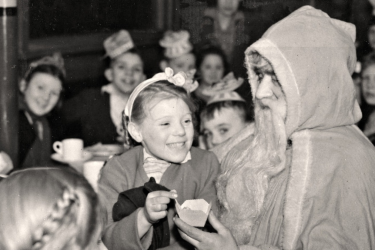
Even during the war, Santa helped bring people together. In 1943, for example, a group of American troops stationed at an RAF depot invited 700 British orphans and schoolchildren to a series of Christmas parties. The celebrations included a Christmas play, with one of the troops dressing up as Santa to help the youngsters ‘enjoy themselves’.
It seems that as soon as ‘Santa’ appeared on Preston’s Christmas scene, he never left and that his popularity only continued to grow. From Victorian charity appeals to wartime celebrations, it appears that throughout the figure’s history we have relied on him to bring some festive magic!
Support Blog Preston: Keep our community reporting going and view the website without any adverts too. Sign up for a membership today.
Stay updated: Keep in touch directly with the latest headlines from Blog Preston, join our WhatsApp channel and subscribe for our twice-a-week email newsletter. Both free and direct to your phone and inbox. Help us report too, by contacting us if you see something we should be reporting on.
Read more: See the latest Preston news and headlines
See us on Google: Set Blog Preston as your preferred source so you don’t miss our stories and see us first when you’re searching
Add Blog Preston as a preferred source on GoogleFeaturing one of the strangest experiences George has ever had at Deepdale.
A 31-year-old has been arrested on suspicion of attempted rape, sexual assault by penetration and two offences of assault causing actual bodily harm

Lancashire and South Cumbria NHS Foundation Trust say Carol Shillabeer will not be starting as planned in January after findings about the culture at the Welsh NHS trust she was overseeing
Get involved in the conversation
 All the festive and Christmas fun and events in and around Preston View collection
 Subscribe
Never Mind The Bollards Podcast
7 Articles
 Each week Blog Preston editors Luke Beardsworth and Ed Walker break down the big talking points and stories in the city, plus our quick-fire round-up of good news. You can find Never Mind The Bollards on Apple, Spotify and YouTube - just search for it. View collection
City Centre Redevelopment
208 Articles


 Preston - it’ll be great when it’s finished. View collection
Help support independent community journalism based right here in the city of Preston in Lancashire. Blog Preston has been going since 2009 and you can become a supporter to help us tell more stories about the city and an annual membership is £60-a-year (£12 cheaper than paying monthly). It’s optional and is not a paywall, plus becoming a member removes the adverts too.
Annual membership
No comments yet. Be the first to join the conversation