


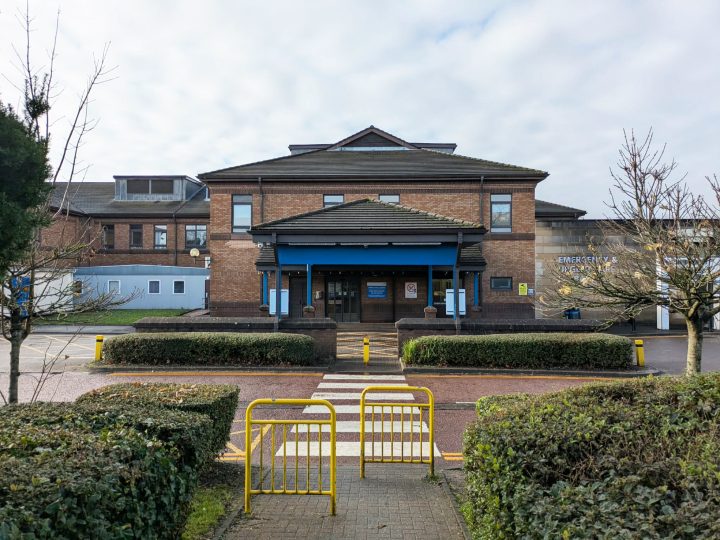
The accident and emergency department at Chorley and South Ribble Hospital is set to reopen 24 hours a day – more than a decade after it last did so.
Staff were advised of the change in a surprise announcement on Thursday morning (19 November).
A firm date for the reinstatement of a round-the-clock service has not yet been fixed, but NHS bosses have said the move will be made during the next financial year, which runs through to March 2028. However, the Local Democracy Reporting Service (LDRS) understands the aim is for it to be up and running before that – by the end of 2027.
Read more: Headteachers to join strike action in response to forced academisation by Catholic Church
The full-time facility will operate on the same basis as the part-time emergency department currently does – and so will not deal with major trauma patients or children, who will continue to be cared for at the Royal Preston.
The 24-hour urgent care centre alongside Chorley A&E will be unaffected by the change and will continue to treat both adults and children with less serious complaints.
A community campaign has seen a group of residents gather at the gates to the Euxton Lane site every Saturday morning for over 10 years, calling for the return of a 24-hour emergency operation.
The A&E currently operates between 8am and 8pm – as it has done since January 2017, apart from a period at the height of the pandemic when it was shut.
The reduced hours were introduced following the complete closure of the service in April 2016. That shutdown – which lasted for nine months – was the result of a chronic shortage of middle-grade doctors. The problem persisted – and meant the department was only able to reopen part time.
NHS bosses say the “fragility” of the available workforce has now reduced, while demand for emergency services has increased hence the decision to restore a 24/7 service.
Back in 2019, Chorley A&E had looked set to close altogether after a group of medics concluded as part of an independent assessment that the facility was not “clinically viable”. However, the onset of the pandemic derailed the public consultation process that could have resulted in permanent closure.
Meanwhile, under growing political pressure, the part-time service continued as government ministers started to make soothing noises about their commitment to the department’s long-term future – and, eventually, a return to 24/7 working.
Leading the political charge was Chorley MP Sir Lindsay Hoyle, who condemned the initial closure and subsequent reduced hours from the outset – but then saw his influence significantly increase when he was elected Speaker of the Commons in November 2019.
Responding to Thursday’s announcement, he told the LDRS that Chorley A&E had been a campaign he “couldn’t give up on”.
“I think people will be very pleased – [and maybe] shocked that finally common sense has prevailed.
“We are a growing population – this decision eases the pressure on other A&Es around the area and also helps the ambulance service. It’s a win-win for everybody,” Sir Lindsay said.
Having witnessed several ministers giving positive nods to the future of the department from their place at the Commons dispatch box, he acknowledged that his role as Speaker had helped secure their interest.
“Every new minister and every new secretary of state got a going over [from me].
“They were all warned that [they’d be] summoned to the Speaker’s office [and asked to] reopen the A&E. So I think somebody just said in the end, ‘We’ve got to stop having to go through this pain.’
“But this is the announcement we’ve always wanted and I’ve got to thank everybody involved for making this happen. Now what we’ve got to do is recruit the [staff] – but they’ll know [according to a recent survey] that they’ll be working in one of the best places to live in the country,” Sir Lindsay added.
South Ribble MP Paul Foster paid tribute to the local people who have “campaigned tirelessly” for a fully restored A&E and have “never given up fighting for it”.
He added: “Having access to emergency care when you need it shouldn’t depend on what time of day it is. For too long, residents needing emergency treatment overnight have faced the prospect of travelling further afield.
“Restoring this service will mean more people can access emergency care closer to home, while helping to ease the pressure on neighbouring hospitals and providing vital reassurance to families across our growing communities.
“Since being elected, I’ve worked closely with Sir Lindsay Hoyle… and NHS leaders to make the case for reopening, including raising the issue directly in Parliament and meeting with Wes Streeting during his time as health secretary to discuss the importance of restoring this vital service.”
Recruiting staff ‘not the problem it was’
Lancashire Teaching Hospitals NHS Foundation Trust (LTH), which runs Chorley and South Ribble Hospital and the Royal Preston, has stressed that the 24-hour reopening of Chorley A&E remains subject to considerations including “clinical safety, affordability [and] operational readiness”.
However, the organisation says it is confident that the recruitment problems that dogged the emergency department for so long are now a thing of the past – and that in-depth planning and an active search for staff can now begin.
On the financial front, the NHS Lancashire and South Cumbria Integrated Care Board (ICB) – which commissions health services across the sub-region – has added a round-the-clock operation at Chorley A&E to the facilities it intends to fund in 2027/28.
LTH chief executive Professor Silas Nicholls said he was “delighted” that the preparations for that service could now begin in earnest.
Asked by the LDRS what the catalyst had been for a decision that had seemed so distant for so long, he said a variety of factors had underpinned it – including ease of recruitment and increased demand for A&E services.
“[Even] four or five years ago, we were struggling to recruit key clinical roles – but what we’re finding now is that that’s improved immensely.
“Additional training posts [have been] put into medical and nursing places [at a national level] – and in Preston and Chorley, we’ve done a lot of work in terms of making both of our hospitals more attractive places for people to want to come and have careers.
“Some of that is through the training and development opportunities that we’re offering and some of it’s through the work that we’ve been doing with our partner organisations – in particular, the University of Lancashire.
“Demand is [also] going up across all of our sites – and we know from our modeling work that by increasing the [A&E] hours at Chorley, that allows us to continue to improve our performance in terms of getting patients treated quickly, but will also take pressure off our Preston site as well.
“This allows us to redirect those [Chorley area patients who have been referred to the Royal Preston overnight] back to Chorley, which is good for [them] – because it means they’re not having to do extra journeys and are being looked after more locally,” Prof Nicholls said.
Another key factor in the extension of hours at Chorley A&E was, he said, a delay to the previously expected delivery of a new Royal Preston site close to the M6 in Farington – which could now be more than 15 years away.
“In the borough of Chorley, we’ve seen a lot more new housing developments and there is also an aging population – so we can’t really allow a situation where we just mark time for the next decade. We have to act and acknowledge that some of those facts on the ground have actually changed.
“We’ve also spent a lot of time getting the trust’s finances in a better place, so we can, I think, much more clearly demonstrate value to money for the taxpayer now.
“As a consequence of that, I think we’re getting a better hearing from commissioners and NHS England about opportunities to expand and develop services,” Prof Nicholls added.
The LDRS understands the funding for the expanded service will be managed through existing NHS budgets, including via the national tariff paid for urgent and emergency care.
Professor Craig Harris, chief commissioning officer at the Lancashire and South Cumbria ICB, said: “Working with Lancashire Teaching Hospitals NHS Foundation Trust and other system partners, we have been reviewing urgent and emergency care to ensure services across Lancashire and South Cumbria meet the needs of our communities, now and in the future.
“Through this partnership, we have been able to include funding to restore round-the-clock adult Type 1 Emergency Department opening hours at Chorley and South Ribble Hospital in our commissioning intentions for next year.
“We know that this news will be welcome news for Chorley and the surrounding communities – and it reflects our continued commitment to providing strong emergency care services for local people.”
How did we get here?
There was widespread shock when the then 24-hour A&E department at Chorley and South Ribble Hospital was shut down at short notice in April 2016 after it emerged it was minus six of the 14 middle-grade doctors needed to staff it.
The department reopened for 12 hours a day in January 2017, but with seemingly little imminent prospect of it returning to its previous round-the-clock service.
The following summer, informal engagement events were held with the public about the healthcare system in Central Lancashire, including the long-term prospects for Chorley’s emergency department.
However, in 2019, a group of medics concluded the facility was not “clinically viable”. Their assessment came after 13 highly-nuanced options for the future of the unit were published, which local NHS commissioners were charged with whittling down.
The resultant shortlist, which was drawn up at the start of 2020, contained three suggestions to be put to public consultation. The two main options recommend the permanent closure of Chorley A&E and its replacement with one of two versions of an urgent care centre.
Although the status quo of a part-time facility was officially left on the table, it was there only to provide a benchmark position against which the proposed alternatives could be judged.
However, before the public consultation could be completed, the pandemic struck – and Chorley’s emergency department was closed for eight months to enable emergency care to be focused on a single site at the Royal Preston.
Just as the consultation process was set to restart in February 2021, then health secretary Matt Hancock made a surprise intervention and ordered that any survey of public opinion must contain a viable option for the unit’s continued operation.
In response, local NHS chiefs opted to abandon the consultation altogether and instead explore the long-term future of the facility as part of a then embryonic bid to build a new Royal Preston.
Later that year, LTH’s then chief executive, Kevin McGee, said the trust was looking at how it could extend the emergency unit’s opening hours in an “incremental” and “safe” way – but no changes ever materialised.
The preferred site for the new Royal Preston was revealed in December 2024 to be in the Farington area of South Ribble, close to the M6 – and around seven miles closer to Chorley and South Ribble Hospital than the Royal’s current location in Fulwood. However, before the implications of that prospect for the existing Chorley site could be fully explored, the timeframe for opening a new Royal Preston was pushed back by a decade to the early-mid 2040s.
In July, the government revealed that there was now “evidence” to support consideration being given to reopening Chorley A&E 24 hours a day. The health secretary at the time, James Murray, said LTH had carried out a “feasibility study” into the possibility.